Tuesday, December 30, 2008

Debunking the Israeli arguments in the Gaza War '08


Before the first body count was completed, the Israeli media and blogosphere were dusting and using the same pre-packaged pseudo-arguments used to justify Israeli action whenever it wreaks havoc in Palestine (or in Lebanon, which I consider to be the model for this war). Below is a short list of these arguments, and a few words on each one of them.


1/ Yes, 320 people died, but they were terrorists and they deserved it.


UNRWA’s estimation is that at least 62 of those are civilians, given ‘conservative’ estimations based on surveys of hospitals.


BUT John Holmes, UN Undersecretary general, explains: “"That simply encompasses those who are women and children. It does not include any civilian casualties who are men - even though we know that there have been some civilian men killed as well."


So we’re talking 62 women and children. Just them. Remember that.


No civilian estimations among the 1400 injured - at least 750 of them seriously so - were released.


(on a secondary note: the definition of a ‘non-civilian’ is very unclearl it generally includes 'Hamas members and supporters'. Also worth pondering.)


2/ The civilians who died were collateral damage; Israel targets Hamas people but those are hiding in civilian areas. Israel does not target civilians.


Right. So the blockade was supposed to starve the Hamas people, while the rest of Gaza was free to move/import/export at will. Right? Right.


Regarding this war: while the first strikes reportedly hit military stations and security forces, they rapidly expanded to include houses, roads, hospitals and medical centres, mosques (where 5 sisters were murdered), police stations and government building. And the University.


(speaking of the University, here is how BBC News justifies it: “... and a science building at the Islamic University in Gaza, from which many top Hamas officials graduated.

Awesome justification!! Thank you, BBC, for the skillful whitewash!


I will also have you notice that the strikes on Saturday - Day 1 of the Gaza War '08 - started right at the time schoolchildren were heading home.

Israel is deliberately seeking to cause large human damage. At the very (very least), it is not trying to prevent it.


3/ Israel was tired of sitting quietly and minding its own business while Hamas was shooting at it.


First, incursions never stopped, ever since the ‘Disengagement’. Second, I will remind you that Gaza has been under a severe blockade for the past couple of years. And a blockade is hostile action. It is dishonest to say the Israel was sitting idly.


Imagine a really big guy sitting on the rib cage of the skinny dude. And as he comfortably readjusts his position, crushing the dude’s thorax, he reads a magazine. Would he really be minding his own business? Reeeeeally?


Because of the blockade, Gaza’s flowers, bound for export, were thrown in the sea because Israel wouldn’t let them out. The strawberries, also bound for export, were fed to cattle (!!). And goods weren’t allowed in either. No imports, no exports. No movement of people. 49.1% of Gazans are unemployed, because firms are shutting down. Etc.


Not even humanitarian food and medical aid: “UNRWA alone feeds approximately 750,000 people in Gaza, and requires 15 trucks of food daily to do so. Between 5 November and 30 November, only 23 trucks arrived, around 6 per cent of the total needed”.

Israel was surely not minding its own business. It engaged in hostilities. Hard.


4/ “Since Israel withdrew from Gaza, ...”


Okay, stop right here. Withdrew? True, there used to be a bunch of wackos living in settlements in Gaza, protected by soldiers who were exposed to great danger to protect those settlers. So the government removed those settlements and their military protection.


That was a self-serving move: they didn’t do it to “give Gazans a chance for peace/independence/becoming Singapore” or any such argument.


Gaza was not free for a second. The “Redeployment” - a more accurate term than the “Disengagement” - has meant that Israel still controlled the movement of goods, services, and people in and out of Gaza, controlled its air, sea, and ground borders. Still controlled who goes in and out, and continued the policy of separating between Gazans and West Bankers, who needed to ask for a (military Israeli) permit to go to the other zone.


Of course, since the legislative elections of 2006 when Hamas won, the blockade was upped. No money was allowed to flow in, and banks were threatened if they were to transfer money inside the Palestinian territory. Since the summer ’07 mini-civil war and the control of Fatah over the WB, this siege ended in the WB; it has remained in the GS.


And it’s only gotten worse in the past several months. (see argument 3).


5/ The Qassams are creating severe damage in Israel


In the past eight years, eighteen Israelis have died because of rockets launched from inside the Gaza Strip. These rockets are crude, have poor aim, and most have poor ranges.


Since the Israeli disengagement in 2005, “about 150 Palestinians have been killed by its security forces in the territory for every dead Israeli civilian.” (The Daily Telegraph). The article adds: “Faced with this astonishing ratio, Israel's government will find it extremely hard to argue that its response has been proportionate.


Yep.


So, Qassams creating damage? Yes, absolutely.

Probably less damage than accidents caused by migrating geese, but yeah, sure.


6/ Hamas bears the full responsibility for the current crisis


“Yes, Hamas provoked Israel's anger, just as Israel provoked Hamas's anger, which was provoked by Israel, which was provoked by Hamas, which ... See what I mean?”

Robert Fisk


Hmmm, nope. For sure, Hamas bears a good chunk of responsibility. In a sense, it reminds me of the joke with the drunken mouse who would go to the sleeping lion, pull its whiskers, and say “Ana gada3!” (“I’m the big guy here!”).


It has also misled the Gazans into thinking the Hamas had decent defensive capabilities, for when the sh*t hit the fan.


Fatah also, by its now legendary impotence, holds a responsibility. Abbas’ barely concealed hatred for the Hamas people and his refusal to resolve the intra-Pal conflict, preferring Palestinians to die by Israeli hands rather than actually talk to them, is disgusting and also at blame.


Yet this taken into consideration, the above are actually secondary responsibilities, or derived consequences of the main culprit’s actions.


The main responsibility lies in the hands of the Israeli state. Israeli imposed collective punishment on Gaza, first. Israel has been conducting mass-murder in the Gaza strip, and has been destroying civilian infrastructure consistently since 1967. And since 2000, the Palestinians have generally been unable to rebuild what has been destroyed: cement and construction materials are forbidden from entering.


It is ludicrous to blame Hamas for what’s going on when the Israeli actions against Gaza have, at best, been part of a circle of confrontation with Hamas, or at worst on an independent path guided by various military or politics motivations (February elections, anyone?)


7/ “Hamas are terrorists. We cannot negotiate with terrorists!”


Well, aside from one man’s terrorist being another’s freedom fighter (or Army)...


Not that long ago, a terrorist organisation called the Palestinian Liberation Organisation secretly met with the Israeli government in Norway. All throughout the talks, the first Intifada was ongoing in the territories. And it was nasty. Far nastier than the homemade bombs falling in the Negev.


If Israel wanted to negotiate, it would have. It has. It is just no longer interested. But its last Brave Man died in 1995.


8/ The Qassams are nerve-wrecking and scare the children of Sderot.


True. And sincerely sad. And I wish no child had to go through that.


I don’t really need to tell you about the psychological damage caused to Palestinian children, though. (Check the Gaza Community Mental Health Programme, directed by Dr. Eyad Sarraj for more information on that.)


But I will ask you this: how do you justify ‘mass murder’ by ‘scared children’?

Saturday, December 27, 2008

Palestine and the Fallacy of the Human Sunk Costs Theory


Sunk costs are, in economics, costs that cannot be recovered once they’ve been incurred, regardless of what one does afterwards (as opposed to variable costs).


A good textbook example is a non-refundable plane ticket. If you’ve already bought a non-refundable plane ticket, you can’t get your money back, even if you decide not to go.


People would tend, however, to want to go, so as ‘not to waste the ticket’. This is the fallacy of sunk costs: because you’ve already paid for the ticket regardless. So this money should not be part of your decision process anymore.


Of course, if you haven’t bought it yet, it should still be part of your decision process! Then you’d be arguing whether to pay what remains an avoidable fixed cost, still unpaid.


Of course, we all fall into the trap often. “Might as well, I’ve already paid for it” - how many times have you used this sentence?


The Palestinians, however, don’t fall for the fallacy: they do it voluntarily.


Let me explain.


Israel is constantly increasing the Palestinian death toll. Those dead, logically, can be considered as sunk costs: they are non-recoverable.


By pure economic logic, those dead must not be part of any future resistance/negotiation decision by the Palestinians.


Israel’s logic is economically infallible. The idea is simple: you’ve lost all those people already. Put them in the past. Now if you want to avoid more killed - those avoidable fixed costs - you need to play nice. Yalla, bend over.


In fact, an outside observer might agree. By throwing in terms like ‘cycle of violence’ and ‘perpetuating their own misery’, our friendly outsider may agree that Palestinians are essentially ‘bringing it upon themselves’ because ‘they can’t seem to understand that they will be hit even harder if they continue’.


This is where he’d be wrong.


Because the Israeli army isn’t Expedia.com and you don’t ‘tick the box’ where you agree on their rules of engagement. Because the 195 murdered today in Gaza are not comparable to 195 dollars paid on theatre tickets.


Nor are the other 4900 killed since the beginning of the Intifada, which is yet to come to an end.


You cannot quantify pain, humiliation, occupation. The cost was never sunk to begin with. The wound still bleeds, a day, a year, sixty years after.


Israel is playing the wrong game. Whether they genuinely don’t realise, or do and pretend not to notice, it is going to blow up in their faces eventually.


Because here, another theory will be at play - an old bit of wisdom really: “Fear he who has nothing to lose”. Battered, starved, bombed, widowed, orphaned: the Palestinians are dangerously close to that.


Friday, December 26, 2008

My French Christmas wisdom - Monsieur 23, the Iranians, and the Halal shawarma


It was a much shorter queue than last year’s at the Vatican’s Saint Peter’s Basilica, but it still took nearly an hour to get inside the Cathédrale Notre Dame de Paris, a gorgeous (and huge) example of gothic architecture which was built over two centuries, beginning in 1163.


And we didn’t get to sit down, either, but watched the ceremony standing on the sides.


We were surrounded mainly by foreigners: lots of Americans (including a couple behind us who was commenting on how people would be queuing at the Pearly Gates of Heaven... argh!), some Brits, Japanese, and a very nervous short Chinese guy with an SLR camera who kept knocking everyone’s head with his camera’s objective, and whom we nicknamed the Lobster - الكركند - for the evening.


We entered, and found ourselves stuck in what is normally the visit path, and could barely see anything. Nevertheless, hopeful ones occasionally took a photograph here and there, and a Spanish chap actually had his hand raised with the camera for the full hour of the service, recording it.

Now that’s devotion.

And, you know, cramps.


Led by the Archevèque de Paris (Archbishop) André Vingt-Trois (Vingt-Trois is his actual last name, not a succession number of a religious title like Benedict XVI!), the ceremony was nearly an hour and included various stories, songs - good choir! - and prayers. A numerous hats by the Archbishop: the big, high hat, the small red cap, and then no hat at all, then the small red one again...


I’ve always enjoyed Christmas mass. (and no, not because of the hats. I really do.)


We heard the story of the voyage from Nazareth to Bethlehem - which apparently took place because the Roman emperor Quirinius decided to undertake the first census and asked people to register in their places of origin; Joseph being from Bethlehem, the holy family thus had to travel there, where Mary eventually gave birth.

And the Archevèque’s address made me smile - he was saying that “the people staying at home with their champagne and expensive food are trying to forget the misery in the world, whereas they should be here, and embrace Jesus’ love as the way to fight misery in the world...


A nice topic of the sermon, too, was that Jesus-Christ was sent as the Saviour, not by being, well, a big guy who will punch Evil on the nose and everyone will live happily ever after (well, I’m paraphrasing!!) but he arrived as a weak, helpless baby, lying in a manger, and that it was the power of Love (not, not Celine Dion’s song) that was the way for salvation.

Salvation, victory through weakness. Interesting concept, I thought.


Baby Jesus was born in a manger of marble, amongst vanilla-scented candles.


The service was, except for some prayers, conducted entirely in French. I had wrongfully assumed that this Being the Notre-Dame, some elements of foreign languages would be included. Na’ah. We had it Allé-lou-ïlla-style all evening.


I am a bit of liturgical puritan, and to some extent translating everything to local languages makes me wince a little. Were I Catholic, I’m pretty sure my prayers would in Latin... Seriously, doesn’t “In nomine Patris, et Filii, et Spiritus Sancti” sound so much cooler?


Though I do acknowledge the necessity for translating the liturgy into local languages (which I have saluted several times during my trips to non-Arabophone Muslim countries, such as Indonesia or Kosova).


And of course, the French will be French, and people were still bitching at one another INSIDE the church. Seriously, the attitude! During Christmas mass!

One woman started shouting - shouting! - at an Australian man behind her: “stay away from me! He’s been rubbing himself against me all night and now he just grabbed my hand!”

The man, holding a camera with one hand and standing next to his wife who was actually behind the screaming woman - blinked a few times in disbelief. Or lack of comprehension.


Another woman was giving a man some serious attitude - “hey, if you already got communion don’t just stand there in the line!”. There was no line though and the man hadn’t had communion yet but oh well.


'Want a sip?'


Outside the Church were random beggars, and some tanned-skinned demonstrators. Roms, I wondered? Hmmm, no. More Middle Eastern...


And they turned out to be Iranians from Mujahedin-e-Khalq, an armed and militant group in Iran that opposes the government, and whose members and their families - thousands, according to their flyer (which was titled “Save the defenders of Freedom” (huh???)) - were refugees in Iraq.


They were seeking support to fight their potential deportation from Iraq and into Iran or to a third country, as the new Iraqi government, trying to consolidate ties with Iran, was suggesting.

I thought it was funny that anyone was fighting to stay in Iraq. Omar thought it was funny they were demonstrating outside of a basilica on Christmas eve.


Then, to celebrate Christmas, we went for a (halal) shawarma.


No, not from this one - too shady, even for me. But this one was parked right outside of the basilica.


Saturday, December 20, 2008

Blocking access to the Aqsa mosque: It's just another day in East Jerusalem

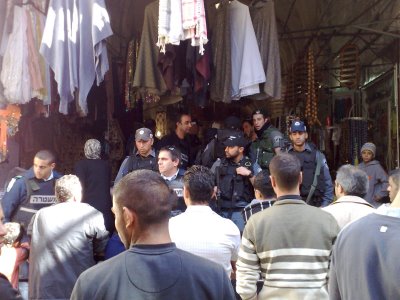
Palestinian worshippers, Israeli police standoff


A couple of weeks ago, the Israeli police evicted a building occupied by violent settlers in Hebron, in a clean, rapid operation.


But violent spillovers ensued. Primarily in Hebron itself, where barbaric Jewish rioters - terrorists is a more apt description - attacked Palestinians, shooting them at point-blank range, organizing in terror gangs and trying to lynch Palestinians. Yes, lynch them.

But it has also spilled over in Jerusalem when the Israeli army decided to forbid all males below the age of 45 from entering the Aqsa mosque, for Friday prayers.


Fear of confrontations between Arabs and settlers”, they said. The few settlers I saw that day, however, walked around the old city just fine. Plus settlers aren’t known to demonstrate in the Old City anyway.

I walked up to the mosque with a colleague from the Jerusalem office, and we were faced with a barrage of Israeli riot policemen. He sighed.


“Again? It used to be like that all the time, a couple of years ago... there’s no way they’re letting me through. You go... Maybe they’ll let you through”.


I figured it was worth a shot. This is likely my last Friday in Jerusalem...

So onwards I went.


The first door was completely blocked - no access through the gates of the Old City.
I tried all my excuses: "foreigner?" "diplomat!" "hmm... tourist!"

Nope.
I considered joining the crowd that was having its own alternative friday prayer outside of the city gates...
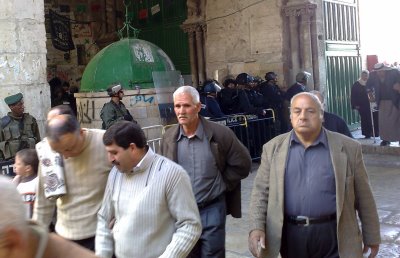
You can see the Israeli police barrier in the background...


Then decided against it.
Door number 2 - the main Bab El Amoud/Damascus Gate entry. The soldier was in a better mood, and the 'foreigner' card worked fine. I was in the Old City.


Getting onto the Haram-El-Sharif/Temple mount was another story though. I must have tried five or six gates...


The interesting part really was the 'negotiations' between Palestinian Jerusalemites and the Israeli police. The former were bolder than the West Bankers, the latter far more contained than the Army soldiers I usually see in the Occupied territories. One of them, believe it or not, actually apologised to people for not letting them through!
(yes, these are policemen in East Jerusalem, the others are trigger-happy soldiers in the Wild Wild West Bank. But still.)

Anyways. At gate number 6 or something - the one that's all the way down by the Kotel entrance - and a few minutes before the end of the prayer, I found a police officer who thought it would be fun to quiz me on religion:
"recite the fatiha!", he asked in Arabic.
"like, now?"
"Yeah, yeah!"
So I give a hurried, school-like reading.

Then it's time for the quiz. He goes:

"I testify...?"


What the fuck is that, a 'fill-in the blanks' exercise? Grmbl grmbl....

"that there is no God but God and Mohammad is his prophet", I answer.

Soldier smiles smugly. His buddies are enjoying the show.
By that time the prayer was already ending - at which time he decided to let me go.
I darted to see the prayer ending.

Anyways. A much lower than usual attendance at the Aqsa, unsurprisingly. Women, old men and children, that's who was there.


Needless to say, nothing happened on that day, no confrontations, demonstrations, nothing. Disappointed photojournalists sat at the Old City cafes, sipping tea and eating knaf'e.


Just another day in Jerusalem.


Sunday, December 07, 2008

Egypt-Israel: The taboo border crossing

I find borders fascinating. While some borders are quasi-inexistent (did you ever drive from France to Belgium? You won’t even notice you crossed...) some separate economically disparate worlds (Dare I say Mexico-USA?) or, in some rare occasions, separate countries that have, for decades and until recently, been diametrically opposed - politically, culturally, historically, who have stood on opposite sides of trenches, and who have lost men and women to defend these very borders.


The Egyptian-Israeli border is one of these.


Even if the huge “CASINO” sign at the border doesn’t give that away immediately!


Curiosity - and money concerns! - led me to take the bus from Jerusalem to Cairo, thus crossing the Eilat/Taba border at around 4:00 AM.

(a few travel tips, by the way, are available here. You're welcome).


That was nearly 10 meters from the border. We hadn't cleared customs yet..


Israel-Egypt: the night ride


The Israelis cleared me relatively rapidly. The Egyptians kept me hanging around for like an hour - not too many Egyptians cross through there.. But I guess once you’ve done the fajr prayers with the border police, it somewhat breaks the ice!


The odd couple


At the very border - after Israeli customs, and before the Egyptian one - I looked up and, for an entire minute, observed the two flags, fluttering in the windy starless night. Not sure what I felt. Probably a mix of disbelief, amusement, and wonder. No resentment or any such thing: I never really doubted that this border should be open (I do cringe at some provisions of the peace agreement, but that’s a different story). No, I just found it objectively interesting. A little like, I don’t know, watching a shooting star, or perhaps a cloned sheep - it’s a little strange, surely unusual, and perhaps even an anomaly - but very much real.


I snapped a few photos, and made my way into Egypt.


The first soldier I spoke to - a friendly 20-something from the falla7een - was somehow under the impression that I was coming from somewhere else, but arrived through Israel. He was almost reproachful - “and you couldn’t find anywhere else to come through?”.

Took forever to get through Egyptian customs, then another eternity to find transportation into Cairo. But eventually, I made it there!


I love those (probably hand-written) signs...


Cairo-Taba-Cairo-Taba-Eilat-Jerusalem (yes, that was the route)


The return journey was in broad daylight, allowing for the visual contrasts between the good ol’ “Welcome to Egypt”, and the big sign on top of the Israeli terminal. Although, truth be told,

the Egyptian terminal is pretty shiny from the outside, too.


I was actually rejected EXIT by the Egyptians. You read this right: forbidden EXIT from my own country! Turns out, an obscure - and unpublished, I checked - regulation requires a pair of special permits to go to Palestine or to Israel from various government authorities.


So I was actually sent back to Cairo (hence a grand total of 1100 pointless kilometers), where I was stuck for 3 painfully long weeks and during which I made calls, pulled strings, etc - and got my permits. I was back at the border crossing the very next morning...


On the road out of the border post. The distinction involves paying an entry tax, so it's less ugly than it looks.:)


Another hour on the Egyptian border - they love me, what can I say? - followed by a crowded crossing - a large group of elderly Brazilians with yellow and green “on the footsteps of Jesus” t-shirts, coupled with a brief border closure on the Israeli side - which led to a long queue by the border line, with the Israeli officers observing us queuing from across the border with binoculars...


I took a photo with one foot in each country. On the spot it was more amusing than anything. Thinking back though, I now realise it’s rather amazing that I have the chance to do that. I mean, really? Crossing into Israel, on foot? I am one of the lucky few - of my country, particularly, to have had the chance to do the journey.

Right now, peace sounds like a very good plan...


Left foot in Egypt, right foot in Israel. And yes, I wear sandals. Bite me.


The Israeli officers kept me for over an hour, going as far as to call the Foreign Affairs officer who signed my visa to check whether it was still valid (!!). But they finally let me through.


And onwards to Eilat, a plastic-and-neon city that’s even more soulless than Sharm-El-Sheikh, if that’s even possible... then Jerusalem and Ramallah.


Back to the holy land. Gotta love this place.


(Related post: travel tips)


Palestine/Israel to Egypt: the practical travel tips you've been looking for

I've had some trouble finding info on that trip - especially the bus timings - so that's my Public Service Announcement. :)

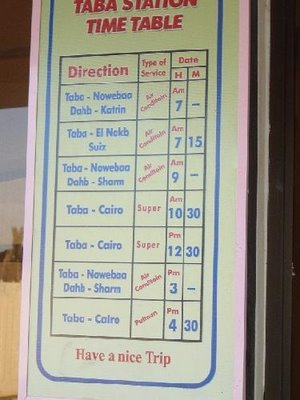
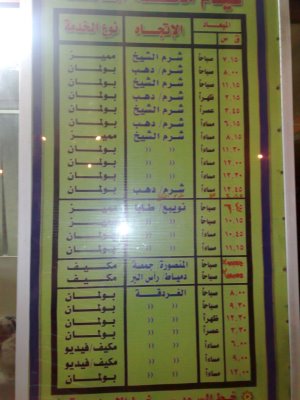
- Don’t take a tourist bus from Jerusalem to Cairo (with that Mazada company, etc). It’s a rip-off. Twice as expensive, plus they don't wait for you at the border if you have a slight delay! Check the bus timings - Egged website for the first leg, and photos below for the second - to see when the regular and cheaper (and totally comfy) buses are. Oh, and in Taba, don’t trust the Bedouins with their minibuses. They are godless thieves and will triple-charge you. And the minibuses are extremely uncomfortable for such a long ride (5 or 6 hours).


Taba to Cairo

Cairo to Taba: daily at 6:45, 10:15, 10:45, 11:15 am (from Almaza station)


- Don’t arrive to Eilat on Friday or Saturday: there are no buses from there to anywhere, and I mean anywhere!! Apparently, God vetoed the transportation schedules in Israel. :) I had to share a *very* expensive taxi with a couple of people out of there...

And don’t arrive to Taba after 6 pm or before 10 am. No buses to Cairo from there either. No act of God involved there, as far as I know.


- If you are Egyptian, well, your government essentially doesn’t want you to go! (to Palestine nor to Israel: same country, as far as the police is concerned). If you insist, you need to request an authorisation from Mogamma El Tahrir, first floor, window 56. You can reach the officers in charge at 02-29627100. The application form costs 30 piastres (piastres, not pounds - so, yeah, 6 cents). You need to submit documents proving the reason you're going (which is work, for most requests). And start working your connections, because you’re more likely to see it snow in Cairo than to get the permit the ‘normal way’. Then you wait - depending on how efficient your connections are, it can take you anywhere from 2 weeks to 2 months. So hone your connections!